



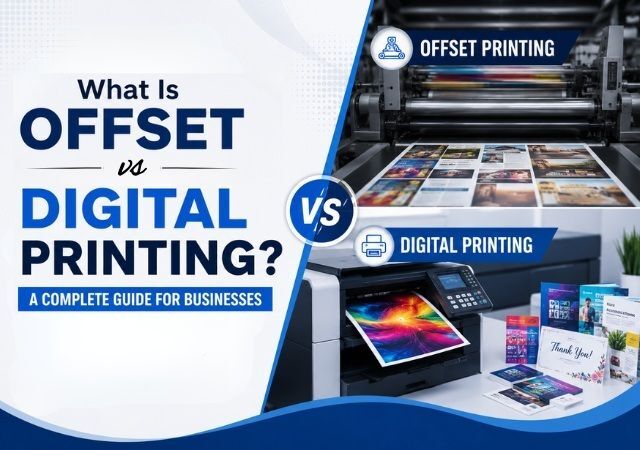
Choosing the right printing method can make a big difference in your project’s cost, quality, and turnaround time. Whether you're printing business cards, brochures, or large marketing materials, understanding the difference between offset vs digital printing is essential for making the right decision.
Many businesses often ask what offset printing is and how it compares to digital printing. While both methods are widely used, they work differently and are suited for different types of projects.
In this guide, we’ll break down offset vs digital printing, explain how each method works, and help you choose the right option based on your business needs.
Offset printing is best for high-volume, high-quality, and cost-efficient bulk production, while digital printing is ideal for fast and flexible short runs.
What Is Offset Printing?
Offset printing is a traditional printing method that has been used for many years, especially for large-scale commercial printing. It is known for delivering high-quality, sharp, and consistent results, which makes it a popular choice for businesses that need bulk printing.
This method is commonly used for printing materials like magazines, brochures, catalogs, and newspapers.
How Offset Printing Works
Offset printing uses a multi-step process that involves transferring an image from a plate to paper indirectly.
Here’s how it works in simple terms:
- The design is first transferred onto metal plates
- Ink sticks only to the image areas on the plate
- The image is then transferred onto a rubber blanket
- Finally, the rubber blanket presses the image onto paper
This indirect process helps create clean, crisp, and high-quality prints. However, because plates need to be created for each color, there is an initial setup time and cost.
Web Offset vs. Sheetfed Offset
Web Offset Printing
Web offset printing uses large rolls of paper that run continuously through the press at high speed.
It is best suited for:
- Newspapers
- Magazines
- Large catalogs
- High-volume printing jobs
Sheetfed Offset Printing
Sheetfed offset printing uses individual sheets of paper instead of rolls.
It is ideal for:
- Brochures
- Business marketing materials
- Specialty prints
- Medium-volume projects
It also offers more flexibility in terms of paper types and finishes.
Benefits of Offset Printing
- High-quality and professional results
Offset printing produces sharp, clean images with fine detail, making it ideal for materials where print quality matters. - Excellent color accuracy and consistency
This method ensures precise color matching, which is especially important for maintaining brand consistency across large print runs. - Cost-effective for large quantities
While there is an initial setup cost, the cost per unit decreases significantly as the quantity increases, making it economical for bulk printing. - Works with a wide range of materials
Offset printing supports various paper types, textures, and finishes, giving businesses more flexibility in their print projects.
Offset Printing: Pros and Cons
Pros of Offset Printing
- Delivers very sharp and consistent image quality
- Lower cost per unit for bulk printing
- Ideal for maintaining brand color consistency
- Suitable for a wide variety of materials
Cons of Offset Printing
- Higher initial setup cost
- Not suitable for small print runs
- Takes longer to set up compared to digital printing
- Limited flexibility for quick changes
Best Use Cases for Offset Printing
Offset printing is the best choice when you need:
- High-volume magazine or book printing
- Newspapers and catalogs
- Bulk brochures and marketing materials
- Premium packaging
- Projects that require precise color matching
What Is Digital Printing?
Digital printing is a modern printing method that allows you to print directly from a digital file without using plates. This makes it faster, more flexible, and more convenient for many businesses.
It is especially useful for short runs and projects that require quick turnaround.
How Digital Printing Works
Digital printing mainly uses two types of technologies: inkjet and toner (laser) printing. Both methods produce high-quality results, but they work differently and are suited for different types of projects.
Inkjet vs. Toner Digital Printing
Inkjet Printing
Inkjet printing uses tiny droplets of liquid ink that are sprayed directly onto the paper. This method is known for producing rich colors, fine details, and smooth gradients, making it ideal for image-heavy designs.
Because of its precision, inkjet printing works especially well for projects that require a high level of visual quality.
Best for:
- High-resolution images and photos
- Marketing materials with heavy graphics
- Posters and creative designs
- Projects with color gradients and shading
Toner (Laser) Printing
Toner printing, also known as laser printing, uses powdered toner instead of liquid ink. The toner is fused onto the paper using heat, which makes the printing process faster and more efficient.
This method is commonly used for business documents and materials that are more text-focused.
Best for:
- Text-heavy documents
- Business reports and manuals
- High-speed printing jobs
- Large batches of simple designs
Benefits of Digital Printing
- Fast turnaround time- Digital printing requires little to no setup, which means jobs can be completed quickly. This makes it ideal for urgent projects and tight deadlines.
- No setup cost- Unlike offset printing, digital printing does not require plates or complex preparation, reducing upfront costs.
- Ideal for small quantities- It allows businesses to print only what they need, avoiding unnecessary bulk printing.
- Allows easy customization and personalization- Digital printing supports variable data printing, making it perfect for targeted marketing campaigns.
Digital Printing: Pros and Cons
Pros of Digital Printing
- Quick and easy to start
- Cost-effective for small runs
- Supports personalized printing (variable data)
- Faster delivery time
Cons of Digital Printing
- Higher cost per unit for large quantities
- Slightly less color accuracy than offset
- Limited material options
- Not ideal for large-scale production
Best Use Cases for Digital Printing
Digital printing works best for:
- Business cards
- Flyers and posters
- Postcards
- Direct mail campaigns
- Short-run marketing materials
Offset vs. Digital Printing: Key Differences
Understanding the key differences between offset vs digital printing helps you choose the right method based on cost, quality, speed, and project requirements.
Feature | Offset Printing | Digital Printing |
Cost | More cost-effective for large quantities | Better for small print runs |
Print Quality | Superior color accuracy and consistency | High quality but slightly less precise |
Speed & Turnaround | Slower setup, faster for bulk jobs | Very fast with no setup required |
Customization | Best for uniform prints | Allows personalization and variable data |
Print Volume | Ideal for large-scale production | Best for small to medium quantities |
When Digital and Offset Printing Work Together
Rather than choosing one method over the other, many businesses use both digital and offset printing together as part of their overall print strategy. Combining these methods allows companies to balance cost, efficiency, and customization based on different project needs.
For example:
- A business may use offset printing for large quantities of brochures or catalogs to reduce cost, and then use digital printing to create personalized versions for targeted marketing campaigns.
- A retail brand might print bulk promotional materials using offset printing, while using digital printing for short-run offers or location-specific promotions.
- A publisher could print books in large volumes using offset printing and rely on digital printing for reprints or customized editions.
By combining both printing methods, businesses can get the best of both worlds cost-effective bulk production, fast turnaround, and personalized content when needed. This approach helps ensure that every print project is both efficient and tailored to specific goals.
How to Choose the Right Printing Method
Choosing between offset vs digital printing depends on a few important factors. Here’s a simple way to decide based on your needs:
Budget
If you’re working with a smaller budget or printing a limited quantity, digital printing is usually the better choice because it has no setup cost.
For larger projects, offset printing becomes more cost-effective as the quantity increases.
Quantity
For small runs, digital printing is more practical and affordable.
For large volumes, offset printing is the better option because the cost per unit becomes much lower.
Timeline
If you need your prints quickly or on short notice, digital printing is ideal because it requires little to no setup time.
If you’re planning a large campaign in advance, offset printing works well and delivers consistent results.
Customization Needs
If your project requires personalization, such as printing different names or messages, digital printing is the best choice.
If all prints are the same and consistency is important, offset printing is more suitable.
Common Printing Mistakes to Avoid
Many businesses make simple mistakes when choosing a printing method. Avoiding these can save both time and money:
- Choosing offset printing for small quantities, which increases cost unnecessarily
- Using digital printing for large bulk orders, which can become expensive per unit
- Not preparing print-ready files correctly, leading to delays or poor results
- Ignoring paper type and finish, which can affect the final look and feel of the print
FAQs
What is offset printing used for?
Offset printing is used for large-scale projects like magazines, catalogs, and bulk marketing materials.
Is digital printing cheaper than offset printing?
Digital printing is cheaper for small runs, while offset printing is more cost-effective for large quantities.
Which printing method is best for small businesses?
Digital printing is usually the best choice for small businesses due to its flexibility and lower upfront cost.
Conclusion
Printing plays a key role in how your brand is presented, and choosing the right method can make a significant difference in both quality and cost. Understanding how offset and digital printing work, along with their strengths and ideal use cases, helps ensure better decision-making for every project. At ABC Printing Company, this expertise is used to deliver consistent, high-quality results that meet business needs with precision, efficiency, and reliability every time.
