



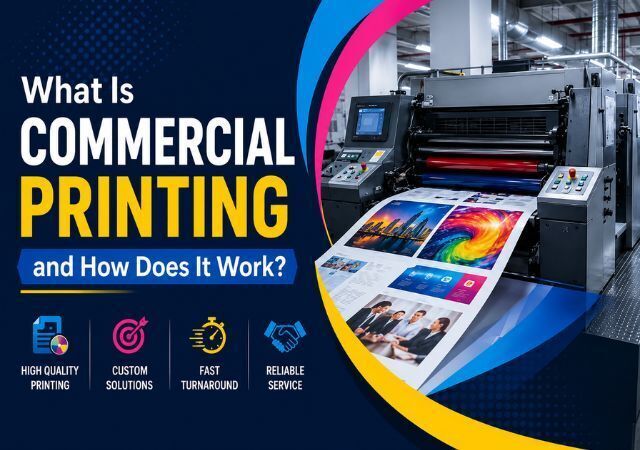
Printed materials still play an important role in business communication. Companies use business cards, brochures, catalogs, postcards, labels, banners, and other printed materials to share information and support their marketing efforts.
But what is commercial printing, and how is it different from printing documents in an office? Commercial printing uses professional equipment and production methods to create printed materials for business and organizational needs. The right approach depends on factors such as quantity, material, design, personalization, deadline, and final use.
What Is Commercial Printing?
Commercial printing is the professional production of printed materials for businesses, organizations, institutions, and other professional purposes. Projects can range from smaller print runs to large-volume production.
Unlike a standard office printer, commercial printing equipment can handle a wider range of materials, sizes, colors, and finishing requirements. It is designed for projects that require consistency, high volume, or specialized printing capabilities.
Commercial printing can include:
- Business cards
- Brochures
- Flyers
- Postcards
- Catalogs
- Booklets
- Books
- Envelopes
- Presentation folders
- Labels
- Posters
- Banners
- Direct-mail pieces
- Trade show materials
The printing method is usually selected based on the project's specific requirements rather than using the same process for every job.
What Are the Types of Commercial Printing?
Several types of commercial printing exist, each suited to different applications. Common options include digital, offset, large-format, and specialty printing.
Digital Printing
Digital printing produces printed materials directly from a digital file without the need for traditional printing plates.
It is useful for short and medium print runs, projects with frequent design changes, and materials that require personalization. Digital printing can also support variable data, allowing individual pieces to contain different names, addresses, offers, or other information.
Common applications include:
- Business cards
- Flyers
- Postcards
- Brochures
- Invitations
- Personalized direct mail
- Marketing materials
This flexibility makes digital printing useful when a project needs customization or a relatively quick turnaround.
Offset Printing
Offset printing uses printing plates to transfer an image to a rubber blanket and then onto the printing surface. It has been widely used for high-volume print production.
Offset printing can be a practical choice when a business needs a large quantity of identical materials. Once the press is prepared, larger print runs can be produced efficiently with consistent results.
Common applications include:
- Catalogs
- Brochures
- Books
- Booklets
- Annual reports
- Corporate stationery
- Large marketing campaigns
Because offset printing involves setup, it may be less practical for very small quantities or highly personalized projects.
Large-Format Printing
Large-format printing is used when printed materials need to be much larger than standard documents.
Typical applications include:
- Banners
- Posters
- Signs
- Trade show displays
- Event graphics
- Promotional displays
Select the material based on where the finished product will be used. For example, an outdoor banner may require different material and durability than an indoor display.
Specialty and Packaging Printing
Some projects require printing on specialized materials or products. This can include labels, packaging elements, specialty substrates, and materials that need specific finishing techniques.
The appropriate process depends on factors such as the product, surface, durability requirements, design, and intended environment.
Digital Printing vs. Offset Printing
Digital and offset printing are two of the most common methods used for commercial projects. Neither method is automatically right for every job.
For example, personalized postcards may be a good fit for digital printing, while thousands of identical catalogs may be better suited to offset printing.
Quantity, personalization, deadline, material, color requirements, and budget should all be considered before selecting a printing method.
How Does the Commercial Printing Process Work?
A commercial print project usually involves several stages. Each stage helps ensure that the final materials match the approved specifications.
1. Prepress and File Preparation
The process begins with preparing the artwork for production. Important details such as document size, image resolution, fonts, colors, bleed, and file specifications are reviewed.
This stage can identify problems before printing begins. Fixing an artwork issue during prepress is generally easier than discovering it after the full order has been produced.
2. Printing
After the artwork is approved, the appropriate production method is selected.
Depending on the project, this may involve digital printing, offset printing, large-format production, or another specialized process.
During production, the print job is monitored for consistency in areas such as color, alignment, and overall appearance.
3. Finishing
After printing, the materials may need additional work before they are ready for use.
Finishing can include:
- Trimming
- Folding
- Binding
- Coating
- Lamination
- Die cutting
- Embossing
- Foil effects
For example, a brochure may need folding, while a booklet may require binding. A presentation folder may require precise cutting and scoring.
4. Quality Control and Delivery
The finished materials are checked against the approved specifications. Depending on the project, quality checks may include color, alignment, trimming, quantity, and finishing.
After inspection, the printed materials can be packaged and prepared for delivery or distribution.
What Are the Benefits of Commercial Printing?
Professional printing services provide access to equipment, materials, production methods, and finishing options that may not be available through standard office printing.
Better Presentation
Printed materials can have a more polished appearance when the paper, colors, finishing, and trimming are carefully selected.
This can be important for materials that directly represent a business, such as business cards, brochures, catalogs, folders, and marketing pieces.
More Material and Finishing Options
Commercial printing can provide access to different paper stocks, sizes, finishes, substrates, and production techniques.
This gives businesses more flexibility when selecting materials based on how a printed product will be used.
Consistent Branding
Businesses often use several types of printed materials at the same time. Keeping logos, colors, typography, and other design elements consistent can create a more recognizable brand identity.
Consistent production can help maintain the same visual appearance across different print products.
Support for Larger Projects
Producing hundreds or thousands of printed pieces internally can require significant time, equipment, and resources.
Commercial printing allows larger projects to move through a structured process that includes file preparation, printing, finishing, quality control, and delivery.
Personalization
Some commercial printing processes support variable information. This allows businesses to create printed pieces with different names, addresses, messages, or offers while maintaining the same overall design.
Personalization can be particularly useful for targeted direct-mail campaigns.
When Does a Business Need Commercial Printing?
The need for commercial printing depends on the type of project and the quantity involved.
A retailer may need catalogs, postcards, labels, and promotional materials. A professional service company may use business cards, brochures, folders, and direct-mail pieces. A company attending a trade show may require banners, signs, booklets, and other event materials.
Commercial printing can also be useful when a project requires:
- A large number of printed pieces
- Consistent color reproduction
- Custom paper or substrates
- Special finishing
- Personalized information
- Large-format graphics
- Packaging or labels
The important part is matching the production method to the purpose of the project.
How to Choose Commercial Printing Services
Choosing commercial printing services starts with understanding the requirements of the job.
Consider the Quantity
Determine how many pieces are needed and whether the quantity may change. This can help determine whether digital or offset printing is more suitable.
Consider the Material
Paper weight, texture, finish, and durability should match the intended application. A business card, product label, brochure, and outdoor banner may all require different materials.
Consider Personalization
If different recipients need different information, ask whether the printing process supports variable data or personalized production.
Consider Finishing
Think about whether the project requires folding, binding, coating, lamination, die cutting, or another finishing process.
Consider the Deadline
A project needed for an upcoming event may require a different production schedule than a catalog that is being planned several weeks.
Consider the Range of Products
Businesses that regularly produce different printed materials may need a printing provider capable of handling various types of projects.
For example, a commercial printing provider may handle products such as business cards, brochures, catalogs, postcards, labels, envelopes, presentation folders, banners, and other business materials.
Common Commercial Printing Mistakes to Avoid
A successful print project involves more than preparing artwork. Small planning mistakes can result in additional costs, delays, or unwanted materials.
Ordering the Wrong Quantity
Ordering too many pieces can create storage issues, while ordering too few may require another production run later.
Estimate the expected need carefully before placing the order.
Choosing the Wrong Printing Method
Digital and offset printing have different strengths. Choosing a method without considering quantity, personalization, and turnaround can affect the efficiency of the project.
Ignoring Material Requirements
The material should match the intended use. A paper stock that works for an indoor brochure may not be appropriate for an outdoor sign or product label.
Skipping Proofing
Proofing provides an opportunity to check spelling, layout, images, colors, and other details before the full order is produced.
Leaving Too Little Production Time
Printing is only one part of the process. Finishing, packaging, and delivery can also require time.
Planning the complete production schedule can help prevent last-minute problems.
How Commercial Printing Works With Digital Marketing
Print and digital marketing do not have to be separate activities. Businesses can use printed materials to direct people toward online channels.
For example, a postcard can include a QR code that leads to a website or special offer. A brochure can direct readers to an online catalog. A printed campaign can encourage customers to visit a landing page or social media profile.
This combination allows businesses to use physical and digital communication together, with each channel serving a different purpose.
Why Print Still Matters in a Digital World
Digital communication has changed how businesses reach customers, but printed materials continue to have practical uses.
A printed brochure can be kept for later reference. A business card can be shared in person. A catalog can provide detailed product information. A direct-mail piece can bring attention to an online offer.
Print can also complement email, websites, social media, and other digital channels. Instead of viewing print and digital as competing approaches, businesses can use both when they support the same communication goal.
Final Thoughts
Understanding what commercial printing is can help businesses choose the right production method for their projects. Digital, offset, large-format, and specialty printing each serve different purposes.
Before choosing commercial printing services, consider the quantity, material, printing method, personalization, finishing, deadline, and budget. ABC Printing Company provides a range of commercial print products for different business and organizational needs.
With the right planning, businesses can use print effectively alongside their digital marketing and communication efforts.
